> For the complete documentation index, see [llms.txt](https://docs.dryad.app/dryad-documentation/llms.txt). Markdown versions of documentation pages are available by appending `.md` to page URLs; this page is available as [Markdown](https://docs.dryad.app/dryad-documentation/site-planning/coverage-estimation/connectivity-zones.md).
# Connectivity zones
Learn how to place Border Gateways and Mesh Gateways in a Site to ensure connectivity between the Wildfire Sensors and the Silvanet Cloud.
## Plan connectivity
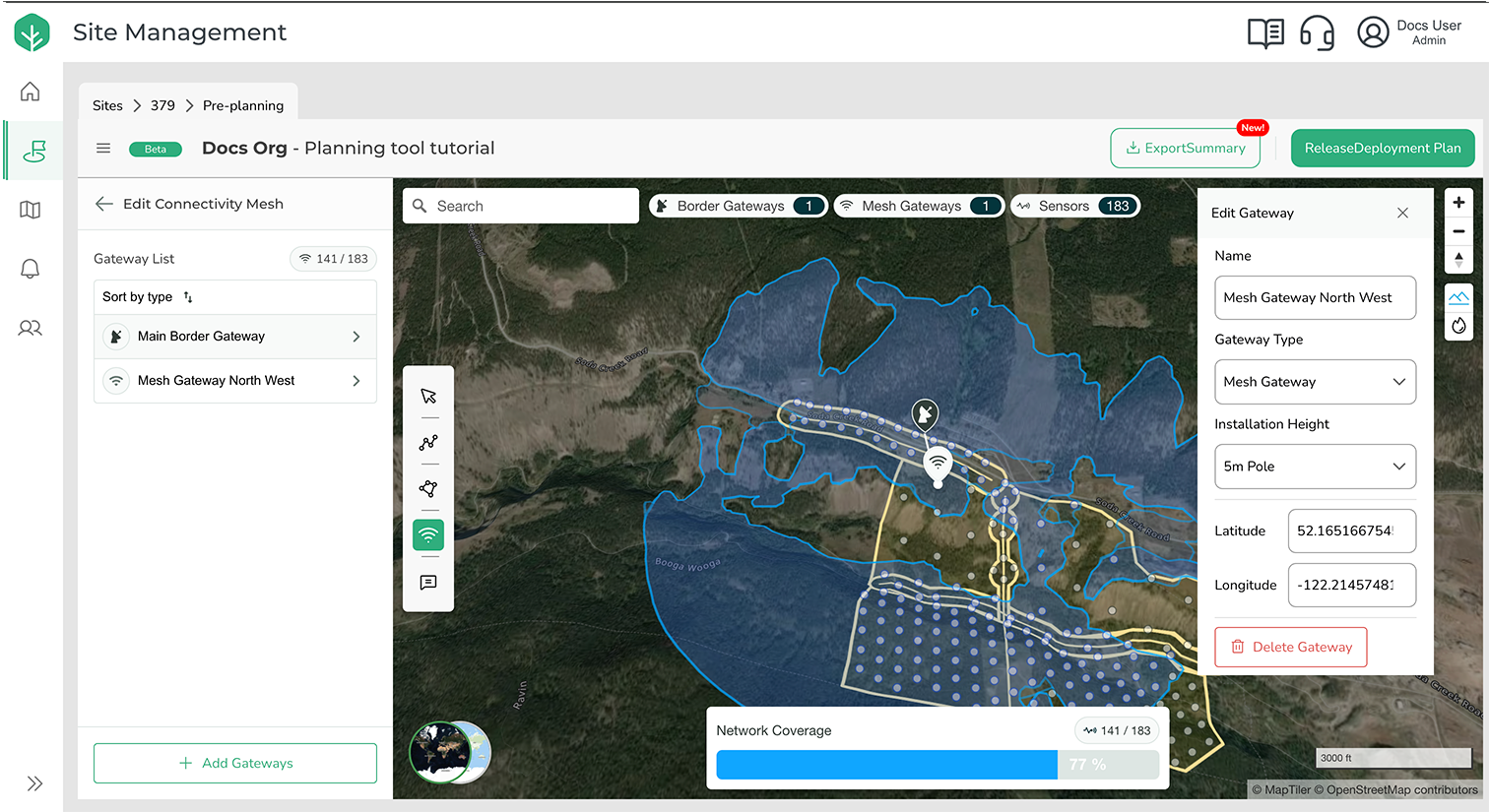
Use the **Plan Connectivity** tool to add Border Gateways and Mesh Gateways to the Site. When adding a Gateway, the Planning tool creates a connectivity zone identified by an irregular blue pattern on the map. This zone shows the range of the Gateway based on several factors including:
* Site topology
* Expected range of the gateway
* Installation height
Areas outside the blue zone do not have **direct Line of Sight** to the Gateway.
### Add Border Gateway
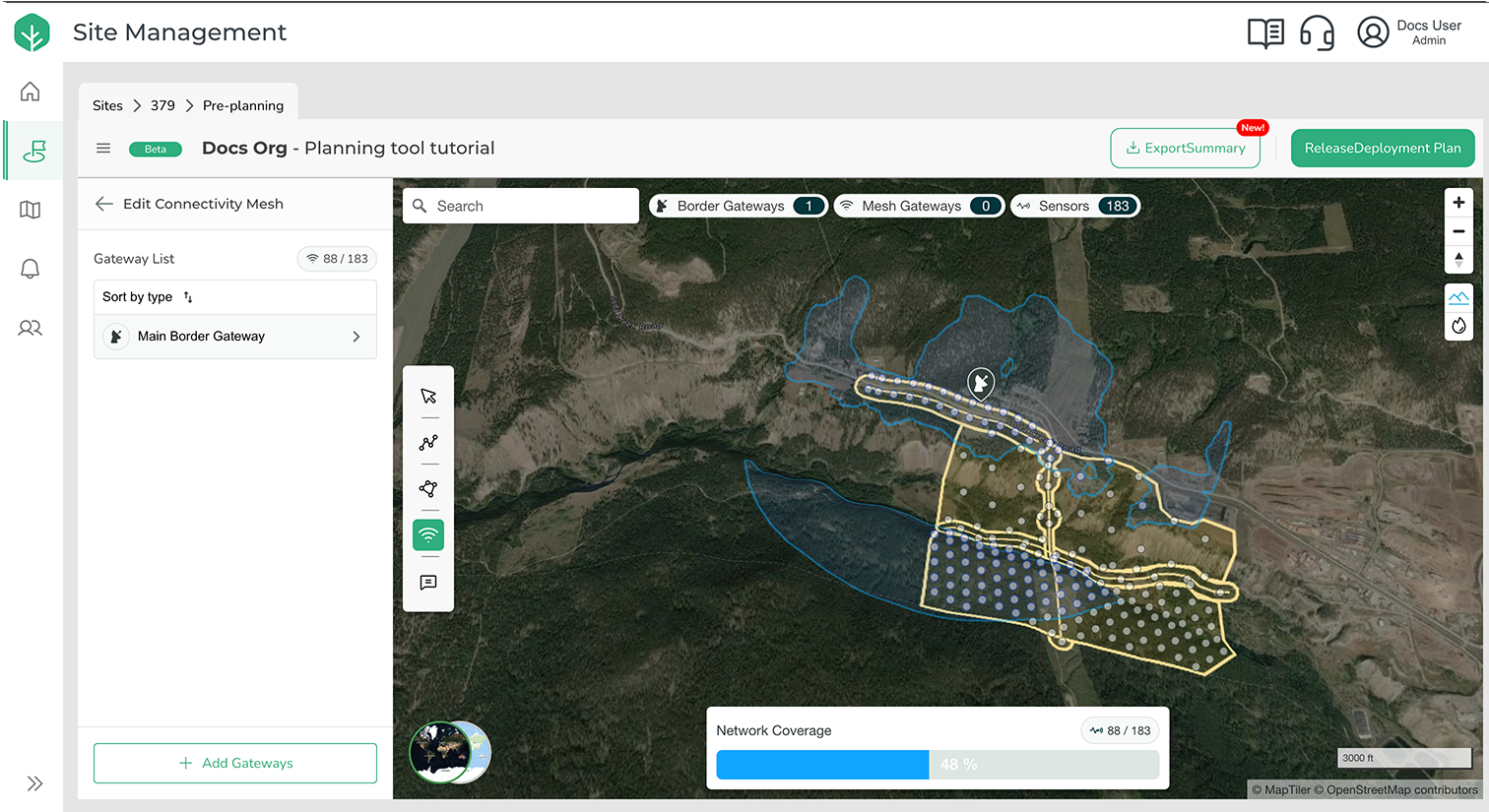
First add a Border Gateway to ensure connectivity to the Internet. Find a location that is at the edge of a forest and, ideally, has access to a mains power supply. Then you add the Mesh Gateways to build up a Silvanet Mesh Network.
Place your first gateway by clicking on the map at the desired location. If you already know where your Border Gateway should be placed, start by placing your first gateway at this location.
Border Gateway added
{% hint style="success" %}
Ensure at least one Border Gateway per mesh network. If you create a site with several Border gateways, account for them manually.
{% endhint %}
1. Select **Connectivity Mesh**, then select **Add Gateways**. A Gateway icon appears on the map.
2. Place Gateway on the Map where you plan on locating it (based on requirements).
3. In the **Edit Gateway** form, set properties:
1. **Name**:\
Identify the Gateway with a name.
2. **Gateway Type**:\
Options include Border Gateway, Mesh Gateway. Choose Border Gateway
3. **Installation Height**:\
Options include 3m Standard, 5m Pole, 10m Tower
4. **Network**:\
Options include Unknown/TBD, Cellular, Satellite
5. **Power Type**:\
Options include Unknown/TBD, Solar, POE
6. **Location**:\
Latitude and Longitude is set automatically based on where the Gateway was placed on the map.
4. Save the project.
### Add Mesh Gateway
Extend Mesh Network coverage by placing Mesh Gateways within the blue zone (connectivity zone) of an existing Gateway.
Mesh Gateway added
1. Select **Connectivity Mesh**, then select **Add Gateways**. A Gateway icon appears on the map.
2. Place Gateway on the Map where you plan on locating it (based on requirements).
3. In the **Edit Gateway** form, set properties:
1. **Name**:\
Identify the Gateway with a name.
2. **Gateway Type**:\
Options include Border Gateway, Mesh Gateway. Choose Mesh Gateway
3. **Installation Height**:\
Options include 3m Standard, 5m Pole, 10m Tower
4. **Location**:\
Latitude and Longitude is set automatically based on where the Gateway was placed on the map.
4. Add additional Mesh Gateways as required.
5. Save the project.
{% hint style="info" %}
**Building a resilient Mesh Network**
To build a resilient mesh network, we advise that each gateway should be in line of sight with at least 2 other Gateways, when possible.
{% endhint %}
{% hint style="info" %}
**Deleting Gateways**
If you need to delete one or all Gateways, see [**How do I delete Gateways from a Deployment Plan?**](/dryad-documentation/resources/faq/site-management-faqs.md#site-management-app-1)
{% endhint %}
### **Estimated network coverage**
After placing the Border and Mesh Gateways on the map, the Planning tool estimates the network coverage. When reaches a high enough coverage percentage, it is indicated by a Sufficient Coverage message.
Network coverage indicator
{% hint style="info" %}
**Connectivity threshold - 95%**
When connectivity reaches 95%, this is considered a threshold for acceptable coverage in a Site.
{% endhint %}
---
# Agent Instructions
This documentation is published with GitBook. GitBook is the documentation platform designed so that both humans and AI agents can read, navigate, and reason over technical content effectively. Learn more at gitbook.com.
## Querying This Documentation
If you need additional information that is not directly available in this page, you can query the documentation by asking a question.
Perform an HTTP GET request on the following URL with the `ask` and `goal` query parameters:
```
GET https://docs.dryad.app/dryad-documentation/site-planning/coverage-estimation/connectivity-zones.md?ask=&goal=
```
`ask` is the immediate question: it should be specific, self-contained, and written in natural language.
`goal` is what the user is ultimately trying to achieve, the reason they need the answer. Sharing it helps GitBook give you a better, more relevant answer. A goal is most helpful when it describes the outcome the user wants rather than restating the question. For example, with `ask=how do I create an API token`, a goal like `automate deployments from our CI pipeline` lets GitBook tailor the answer to that use case.
The response will contain a direct answer to the question and relevant excerpts and sources from the documentation.
Use this mechanism when the answer is not explicitly present in the current page, you need clarification or additional context, or you want to retrieve related documentation sections.